
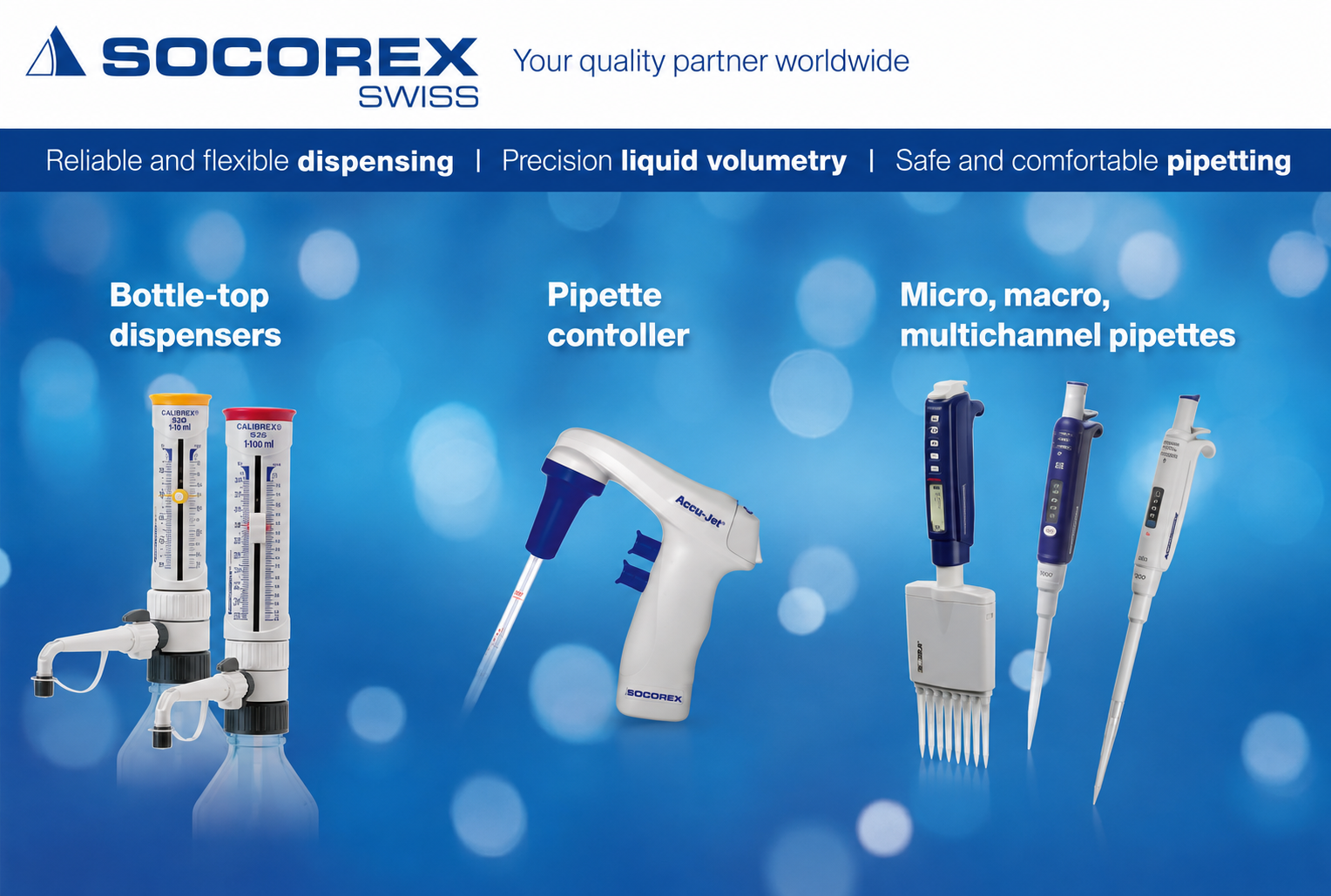
In laboratories where even small variations can influence an outcome, liquid handling equipment plays a critical role in supporting the integrity of each process. Whether transferring microlitre volumes during molecular research or dispensing larger quantities of a controlled liquid, the equipment used must perform accurately and consistently while remaining comfortable for the operator.
Accuracy, reliability and ergonomics should therefore be considered together when selecting pipettes and dispensers. Each contributes to the quality of laboratory work, the efficiency of everyday workflows and the wellbeing of the people performing them.
Accuracy supports dependable results
Accurate liquid handling helps ensure that the volume delivered reflects the volume required by the protocol. This is particularly important when working with small quantities, where even a minor variation can have a proportionally significant effect.
In applications such as cell-based assays, staining procedures, flow cytometry, western blotting and RT-PCR, inaccurate liquid transfer may affect concentrations, reactions and ultimately the data produced. Researchers may then need to repeat procedures, using additional time, samples and consumables.
Accuracy is equally important when dispensing larger volumes. In clinical or pharmaceutical environments, for example, carefully controlled quantities may need to be prepared, monitored and recorded. The precise dispensing of liquid medications such as methadone is one application in which incorrect dilution or dosing must be avoided.
For these reasons, a suitable liquid handling instrument should offer:
- Clear and secure volume selection
- Consistent delivery across repeated operations
- Smooth and controlled plunger movement
- Compatibility with the required volume range
- The ability to be routinely calibrated and maintained
Accuracy should not be viewed as a one-time product specification. It must be supported throughout the instrument’s working life through correct technique, regular cleaning, appropriate storage and scheduled calibration.
Reliability improves laboratory efficiency
A reliable instrument performs consistently from one procedure to the next. This gives laboratory personnel greater confidence in their methods and reduces the likelihood of interruptions caused by leaking tips, unstable volume settings, difficult movements or equipment failure.
Reliable operation is particularly valuable during repetitive or multi-stage protocols. When one stage depends on the accuracy of the previous step, inconsistent liquid handling can introduce variation throughout the workflow.
Instrument construction is an important consideration. Laboratory pipettes and dispensers may be exposed to frequent handling, chemicals, heat and repeated cleaning. Quality materials and robust components can help the equipment withstand these conditions and maintain its performance over time.
Tip compatibility should also be assessed when selecting a micropipette. A poorly fitted tip may cause leakage, compromise volume delivery or increase the force needed to attach and eject it. Choosing an instrument that works securely with appropriate tips can support both accuracy and a smoother workflow.
For bottle-top dispensing, the instrument must also be compatible with the liquid being handled. Solutions containing sugar or syrup, for instance, may crystallise and interfere with the movement of internal components. Suitable instrument materials, combined with regular cleaning, can help reduce blockages and support dependable long-term use.
Ergonomics protects the people behind the research
Pipetting is often highly repetitive. Over the course of a day, a laboratory professional may perform the same hand, finger and thumb movements hundreds or even thousands of times. If an instrument is heavy, poorly balanced or requires excessive force, these movements can contribute to fatigue and discomfort.
An ergonomic pipette is designed to reduce unnecessary physical effort while supporting control and precision. Important features may include:
- A comfortable grip and balanced weight
- Smooth, responsive plunger movement
- Low-force tip attachment and ejection
- An easily accessible ejector button
- Simple volume adjustment, including while wearing gloves

- A design suited to different hand sizes and working positions
Ergonomics is not simply an added comfort feature. Fatigue can affect concentration, technique and consistency, particularly during long or repetitive procedures. A comfortable instrument can therefore support both the user and the quality of their work.
Socorex Multichannel &
Manual Pipettes
Where pipetting demands are high, an electronic micropipette may help reduce repetitive manual movements. Multi-channel pipettes can also improve efficiency when transferring the same volume across multiple wells, provided they are appropriate for the application and used correctly.
Maintenance connects accuracy with reliability
Even a well-designed instrument requires routine care. Residue, contamination, worn components or incorrect storage can gradually affect performance.
Cleaning and maintenance requirements should therefore be considered before an instrument is selected. Equipment that can be easily disassembled and cleaned may help laboratories maintain performance without creating unnecessary downtime. Access to replacement parts, servicing and calibration support can also extend the useful life of the instrument.
A suitable maintenance program may include:
- Inspecting the instrument for damage or contamination.
- Cleaning it according to the manufacturer’s instructions.
- Confirming that tips, adapters and other components fit correctly.
- Calibrating it at appropriate intervals.
- Recording maintenance and calibration activities where required.
- Addressing changes in performance before the equipment is returned to routine use.
For bottle-top dispensers, correct priming is also important. Designs that return liquid to the original bottle during priming can help minimise reagent loss while preparing the dispenser for accurate operation.
Selecting equipment for the application
No single pipette or dispenser will be suitable for every laboratory task. Selection should begin with the requirements of the application rather than the instrument alone.
Consider the volumes being handled, the properties of the liquid, the number of transfers, the level of precision required and the length of time the equipment will be used during each session. Cleaning, sterilisation, tip compatibility and calibration requirements should also be assessed.
Socorex offers several liquid handling options for different workflows, including:
- Acura® Manual micropipettes: designed for versatile manual pipetting across a range of volumes.
- Acura® Electro micropipettes: electronic operation suited to applications where reduced manual effort and flexible pipetting modes are beneficial.
- Calibra® Digital micropipettes: designed for rapid volume setting and dependable manual operation.
- Calibrex™ bottle-top dispensers: developed for repeat dispensing directly from reagent bottles across different liquid handling applications.
The right choice will depend on how well the instrument’s volume range, materials, controls and ergonomic characteristics align with the intended procedure.
Supporting better laboratory outcomes
Accurate and reliable liquid handling helps laboratories protect the quality of their results, minimise avoidable repetition and use valuable samples and reagents efficiently. Ergonomic design supports the people carrying out this work, especially when protocols involve prolonged or repetitive pipetting.
Together, these qualities create a more dependable liquid handling process — from the first volume setting to the final recorded result.

