
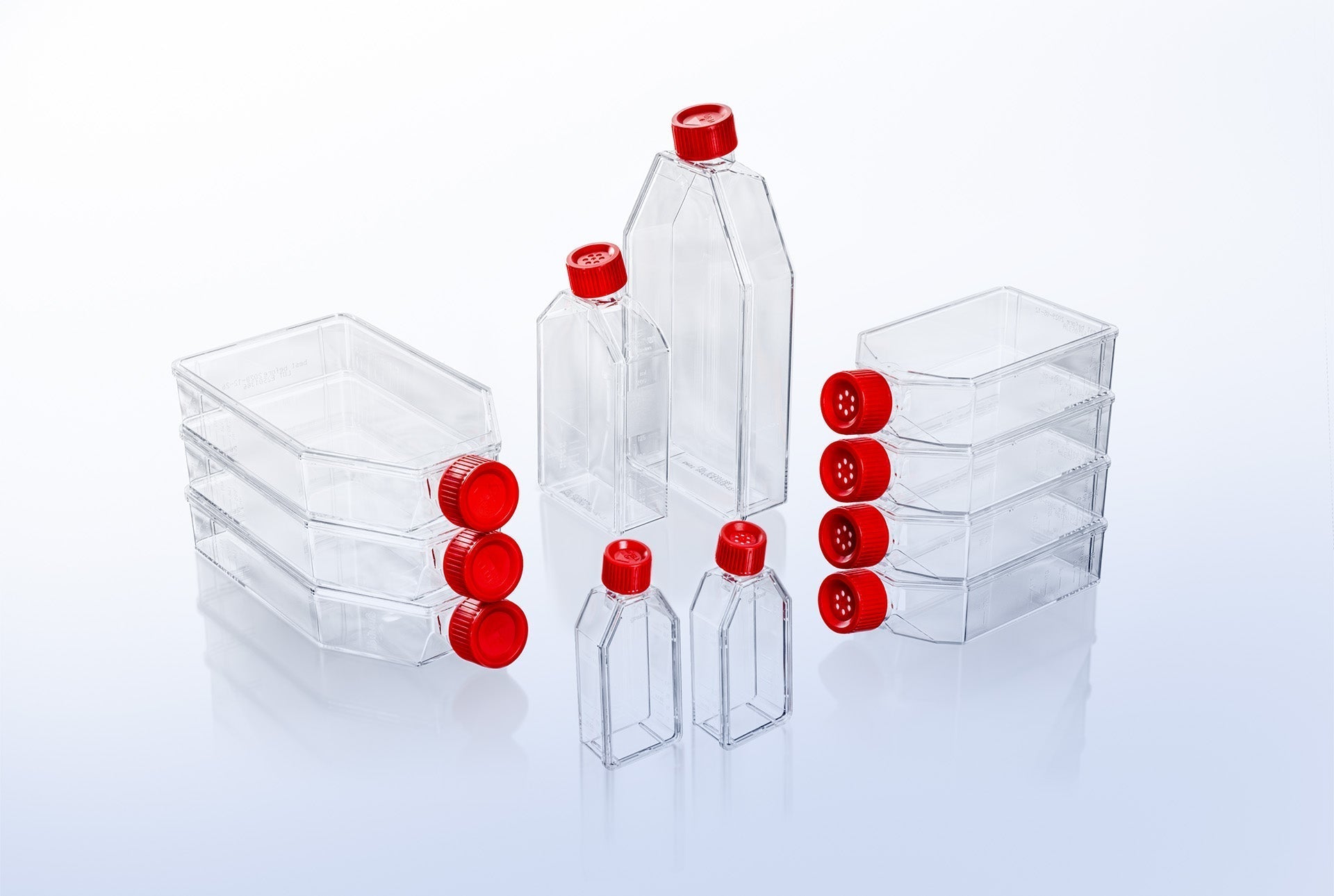
Stem cell research continues to advance our understanding of regenerative medicine, disease modelling, drug discovery and tissue engineering. As researchers strive to produce reliable and reproducible results, considerable attention is often given to media formulation, supplements and growth factors. However, one equally important factor is sometimes overlooked: the cell culture vessel itself.
The surface of a cell culture flask plays a critical role in how cells attach, proliferate and differentiate. For sensitive cell types such as embryonic stem cells, selecting an appropriate culture surface can help maintain pluripotency, reduce experimental variability and support more consistent outcomes.
This article explores how cell culture flask surface technology influences stem cell culture performance and highlights findings from a Greiner Bio-One application study evaluating the cultivation and neuronal differentiation of murine embryonic stem cells across multiple culture surfaces.
Why Cell Culture Flasks Matter in Stem Cell Research
Embryonic stem cells are highly sensitive to their surrounding microenvironment. Their ability to self-renew while maintaining pluripotency depends on carefully controlled culture conditions, with even subtle changes capable of influencing cell behaviour.
While media composition and incubation conditions are essential, the culture surface also contributes to:
- Cell attachment and spreading
- Colony morphology
- Maintenance of pluripotency
- Cell viability
- Differentiation efficiency
- Imaging and downstream analysis
For laboratories aiming to generate reproducible data, selecting the appropriate culture flask is therefore more than a practical decision—it is an experimental variable that can influence study outcomes.
The Challenge with Traditional Stem Cell Culture
Murine embryonic stem cells have traditionally been maintained on feeder layers of inactivated fibroblasts. These feeder cells provide extracellular matrix components and growth factors, including leukaemia inhibitory factor (LIF), helping maintain cells in an undifferentiated state.
Although effective, feeder-layer culture presents several challenges:
- Additional preparation and maintenance
- Greater experimental complexity
- Potential cross-contamination between feeder and stem cells
- Increased variability between experiments
- More complicated imaging, immunocytochemistry and cell harvesting
As stem cell research continues to evolve, many laboratories are moving towards feeder-free culture systems that simplify workflows while maintaining cell quality.
Selecting the Right Cell Culture Flask Surface
Greiner Bio-One Cell Culture Flasks are available with multiple surface technologies designed to support different cell culture applications.
Depending on the experimental workflow, researchers can choose surfaces that promote:
- Adherent cell growth
- Suspension culture
- Stem cell maintenance
- Specialised cell differentiation
Among these are:
- CELLSTAR® TC – Optimised for adherent cell culture.
- Advanced TC™ – A modified surface designed to enhance attachment of demanding and sensitive cell types.
- CELLSTAR® Suspension – Developed for non-adherent applications, including spheroid and embryoid body formation.
Selecting the most appropriate flask surface allows researchers to tailor their culture system to their specific biological application.
What the Research Shows
To investigate the effect of culture surface on embryonic stem cell behaviour, Greiner Bio-One compared five different culture conditions:
- STO feeder layers
- Gelatine-coated cultureware
- CELLSTAR® TC
- CELLSTAR® Suspension
- Advanced TC™
Researchers assessed each surface for its ability to support murine embryonic stem cell maintenance, preserve pluripotency and facilitate neuronal differentiation. Cell morphology was evaluated alongside recognised pluripotency markers including alkaline phosphatase (AP), SSEA-1 and Oct-4.
Key Findings
The application study reported that:
- CELLSTAR® TC and Advanced TC™ maintained pluripotency marker expression comparable to traditional feeder-layer culture.
- Both surfaces supported feeder-free expansion of embryonic stem cells.
- Cells maintained compact colony morphology characteristic of undifferentiated stem cells.
- Advanced TC™ demonstrated strong support for neuronal differentiation following retinoic acid induction.
- CELLSTAR® Suspension effectively supported embryoid body formation for suspension culture applications.
Supporting Feeder-Free Stem Cell Culture
One of the most significant findings of the study was the ability of CELLSTAR® TC and Advanced TC™ to support embryonic stem cell culture without relying on feeder cells.
Cells cultured on these surfaces demonstrated:
- Strong alkaline phosphatase expression
- Positive SSEA-1 staining
- Positive Oct-4 expression
- Well-defined colonies consistent with an undifferentiated phenotype
Marker expression was reported to be comparable with cultures maintained on STO feeder layers while eliminating interference from feeder cells during imaging and analysis. Researchers also observed reduced spontaneous differentiation compared with gelatine-coated surfaces under the same experimental conditions.
For laboratories adopting feeder-free workflows, these findings highlight how surface technology can help simplify experimental design while supporting consistent stem cell maintenance.
From Stem Cell Expansion to Neuronal Differentiation
Beyond maintaining pluripotency, many stem cell workflows require reliable differentiation into specialised cell types.
In the Greiner Bio-One application study, murine embryonic stem cells were differentiated into neuronal cells using retinoic acid followed by cytosine arabinoside selection.
Differentiated cultures were assessed using recognised neuronal markers including Nestin, βIII Tubulin and GFAP.
While successful neuronal differentiation was observed across multiple adherent culture surfaces, Advanced TC™ produced the highest proportion of differentiated neuronal cells and extensive neuronal interconnections under the experimental conditions evaluated. Researchers also demonstrated that neuronal differentiation could be achieved without prior feeder-layer cultivation, supporting a streamlined feeder-free workflow.
Why Surface Technology Matters Beyond Stem Cell Culture
Although this application focused specifically on murine embryonic stem cells, the findings reinforce a broader principle applicable across many cell culture workflows.
Surface characteristics influence how cells interact with their environment, affecting attachment, morphology, proliferation and differentiation. For researchers working with primary cells, sensitive cell lines or specialised applications, selecting an appropriate culture flask can contribute to:
- Improved experimental reproducibility
- Reduced preparation time
- Simplified imaging and analysis
- Easier cell recovery
- Greater workflow consistency
These practical advantages become increasingly valuable as laboratories seek to standardise methods and improve confidence in experimental results.
Supporting Your Research with Greiner Bio-One Cell Culture Flasks
Greiner Bio-One Cell Culture Flasks are designed to support a wide range of cell culture applications through high-quality manufacturing and carefully engineered surface technologies.
Greiner Cellstar Cell Culture Flask,
550ml 175 cm² with Filter Cap,
SKU: 660175

Whether your work involves routine adherent cell culture, feeder-free stem cell expansion or suspension culture, selecting the appropriate flask surface can help optimise workflow efficiency while supporting reliable biological performance.
By combining consistent manufacturing standards with specialised surface options such as CELLSTAR® TC, Advanced TC™ and CELLSTAR® Suspension, Greiner Bio-One provides researchers with flexible solutions for a diverse range of cell culture applications.
Conclusion
The success of stem cell culture depends on a combination of biological, chemical and physical factors. While media formulation and growth factors remain essential, the culture vessel itself plays a significant role in maintaining cell quality and supporting reproducible research.
The Greiner Bio-One application study demonstrated that CELLSTAR® TC and Advanced TC™ surfaces supported feeder-free cultivation of murine embryonic stem cells while maintaining key pluripotency markers comparable to traditional feeder-layer systems. The study also showed that Advanced TC™ effectively supported neuronal differentiation under the experimental conditions investigated.
For laboratories seeking to improve reproducibility, simplify workflows and reduce reliance on feeder-cell culture systems, selecting the appropriate cell culture flask surface is an important consideration that extends well beyond the vessel itself.


References
Greiner Bio-One. Improved Cultivation and Differentiation of Embryonic Stem Cells – Application Note (F073 117), Rev.03/2012.